Call us: +44 01908 040374
  Opening hours: Mon - Fri: 9:00am To 6:00pm





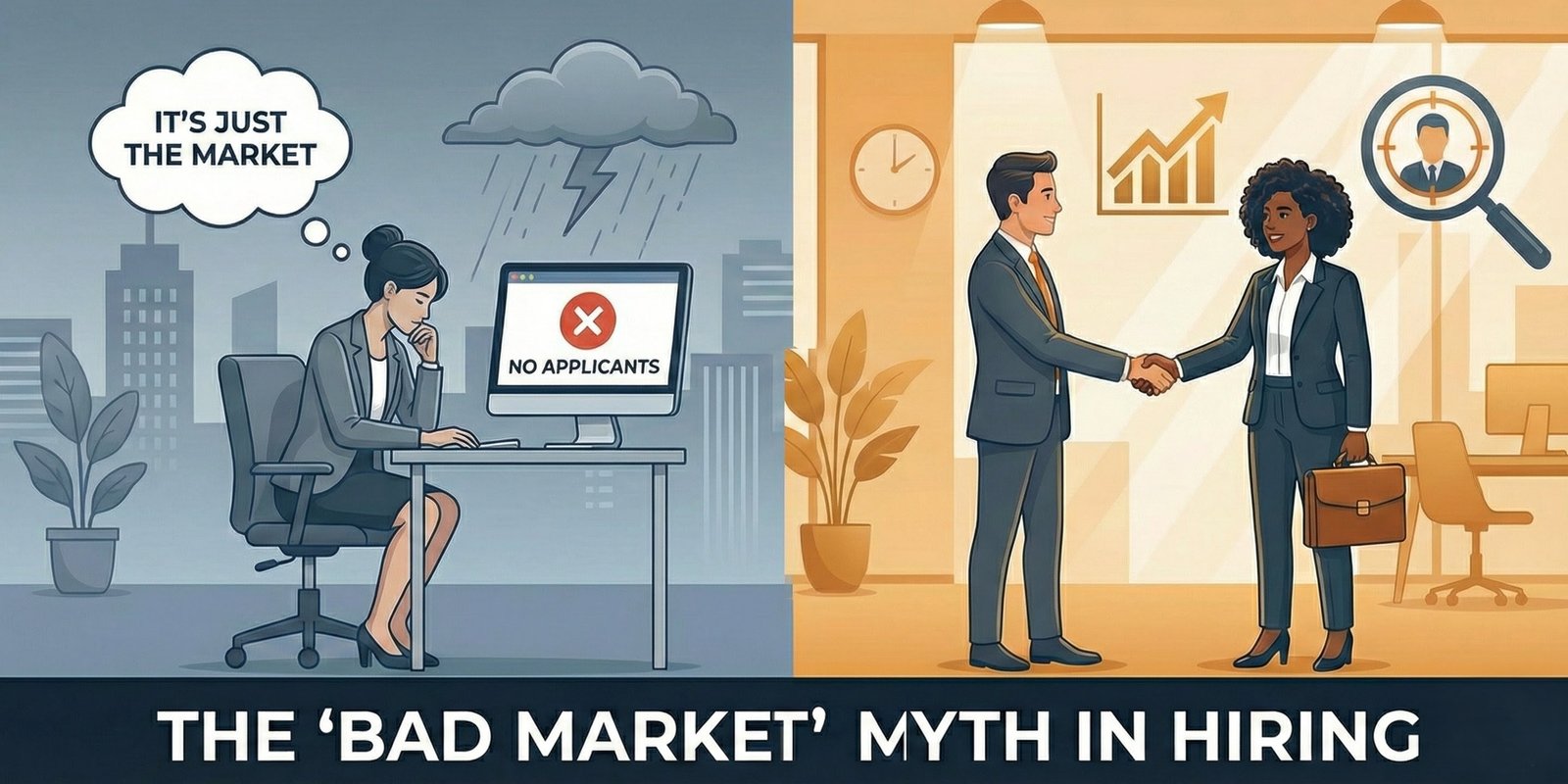
You post a role. You wait. Fewer candidates apply than last year. And the ones who do apply? The quality just isn't there.
In boardrooms and HR meetings across the country, the conversation usually ends with the same comforting conclusion: “It’s just a bad market right now.”
It’s an easy explanation. It absolves us of responsibility. But here is the hard, uncomfortable truth:
Blaming the market is costing you great hires.
While you are waiting for the 'market to turn,' your competitors are still hiring. Strong candidates are still moving. The talent hasn't disappeared; their behaviour has simply changed.
If you are struggling to hire, it’s not because the market is dead. It’s because your strategy was built for a different economic climate.
Here is the reality of the current landscape and the smarter approach you need to take to win.
The Reality: Candidates Are Selective, Not Desperate
In a booming economy, candidates move for a slightly higher salary or a cooler job title. In an uncertain economy (or a 'bad market'), candidates become risk averse.
The top 10% of talent, the people you actually want, are likely currently employed. They are keeping their heads down. They aren't doom scrolling job boards, and they aren't applying to vague job descriptions.
They are still willing to move, but the bar has been raised. They need a compelling reason to leave the safety of their current role for the unknown of yours.
If you want to unlock this talent, you have to stop 'collecting applications' and start selling a verified opportunity. Here is your three step fix.
1. Sharpen Your Employer Value Proposition (EVP)
In a candidate-driven market, you could get away with a list of requirements and a generic 'competitive salary' line. Not anymore.
You need to answer the question: "Why should I risk leaving my current job for this one?"
- Sell Stability: If the market is shaky, highlight your company's growth, funding, or long term pipeline.
- Sell Impact: High performers want to know their work matters. What problems will they solve in the first 6 months?
- Sell Culture: Is there flexibility? Is there a clear path to promotion?
A job description lists duties. An EVP sells a future. You need the latter.
2. Move Faster Than the Competition
There is a misconception that in a 'slow' market, you have the luxury of time. You don't.
Because candidates are risk-averse, a slow hiring process signals danger. It suggests bureaucracy, indecision, or budget issues.
- If you take two weeks to schedule a first interview, the candidate assumes you aren't serious.
- If you drag the process out over 6 weeks, the candidate will withdraw to stay where they are safe.
Speed is safety. A streamlined, decisive process gives the candidate confidence that your business is agile and ready to grow.
3. Focus on Quality Attraction, Not Volume
Stop measuring success by the number of applications. In a tough market, volume is usually just noise (unqualified candidates panic applying).
Shift your metric to conversations with qualified talent.
This means moving away from 'Post and Pray' (inbound) and moving toward proactive headhunting (outbound). You need to identify the passive talent that fits your exact needs and reach out to them personally.
Adaptability Beats Market Conditions
The businesses that are winning right now aren't the ones waiting for the market to change. They are the ones adjusting their sails to the current wind.
- They are refining their pitch.
- They are speeding up their interviews.
- They are hunting, not gathering.
Frustrated by the lack of strong candidates?
It might not be the market. It might be the method.
To discuss your hiring needs and challenges, contact a member of our experienced team on 01908 040374 or hello@stirlingpeoplesolutions.co.uk